Have you ever noticed how some Pilates exercises can feel quite similar to dancing? Why do we have many exercises with turnout positions where you keep your feet in a V shape?
Joseph Pilates initially developed a new method to rehabilitate injured soldiers which became the basis of Pilates. After he moved to New York from Germany, his studio was located in the same building as a dance company. Many ballet dancers started training with him, and over time, ballet elements gradually became integrated into Pilates through the influence of dancers and second-generation teachers.
But why did Pilates become so popular among ballet dancers?
Before diving into that, I’d like to share a bit about my own journey as a former ballet dancer who fell in love with Pilates! I discovered Pilates when I was 19 years old in my second year in the ballet company in Germany. At that time, I was struggling with hip pain. As a dancer I wasn’t really flexible, and I always struggled to get my leg high.
I didn’t have enough knowledge to train and improve my flexibility and muscle endurance to keep my leg in a certain position, so I ended up hurting my hip. Pilates wasn’t as big as it is now back then, but I knew that a few dancers were doing it as a part of body conditioning. Luckily, I found one Pilates instructor nearby who had an idea about dancing and worked with dancers, so I started seeing her every week. Since then, my Pilates journey started and I never stopped!
Why is Pilates so popular among Ballet Dancers?
In my opinion, as dancers we tend to overuse specific muscles. For example, the turnout muscles or the muscles that help us point our feet. Repeating the same patterns every day can create muscular imbalances in the body. And when these imbalances become too significant injuries often follow.
Pilates is perfect for restoring balance. It helps you reconnect with your centre and become aware of posture, habit and which muscles are overactive and which ones are underused.
This is not only important for dancers but for dancers whose body is their work instrument it is essential. Pilates teaches the body to work in harmony. Unlike gym training, which typically isolates one muscle group at a time, Pilates strengthens multiple muscle groups simultaneously, promoting balance and stability. This integrated approach is especially beneficial for dancers to create aligned and efficient movement.
Pilates as a rehabilitation tool
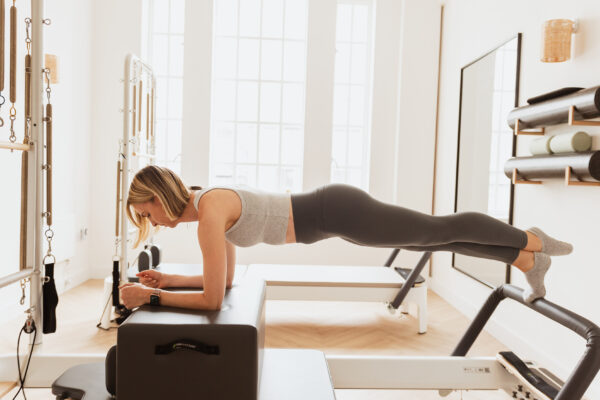
Unfortunately for many dancers injury is part of the journey. But Pilates is an incredible tool for rehabilitation and for returning safely to the studio. On the reformer, you can control the resistance precisely. You can work with both open-chain and closed-chain movements.
At the beginning of rehabilitation, it’s important to focus on simple, controlled exercises to make sure you are activating the right muscles. As you progress, you need more complex, full-body integration work to prepare for the demands of dancing again. Pilates supports this perfectly. It trains the whole body to work together, which requires coordination, control, and awareness. All of these are essential for dancers.
Pilates and Ballet
As a dancer, you can benefit from Pilates in every phase of your career whether you are building strength, preventing injury, recovering, or simply maintaining balance in your body.
Pilates came into my life through ballet but today it has grown into something much bigger.
I now have the joy of training with clients from many different backgrounds and that diversity is what makes my work so meaningful!!
Naoka